

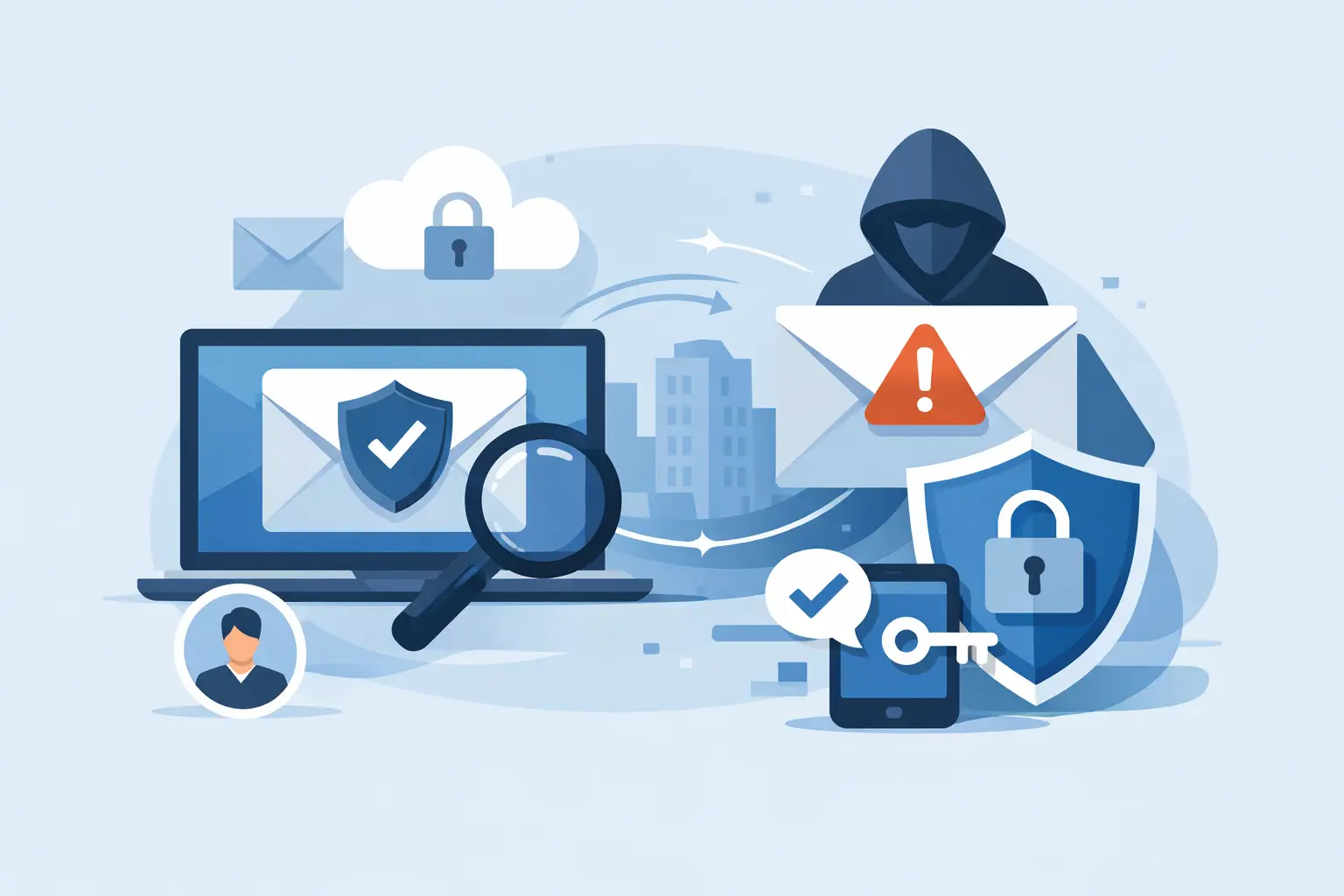
A finance employee receives an email from the CEO asking for an urgent wire update. The display name is right. The tone is familiar. The sender domain looks close enough to pass a quick glance. That is exactly where business email compromise succeeds - not through malware, but through trust, timing, and weak email controls. Email authentication for BEC matters because it gives defenders a way to verify who is actually allowed to send mail for a domain and what to do when that verification fails.
BEC remains one of the most expensive and persistent email threats because it exploits normal business workflows. Attackers do not need a payload if they can convince payroll to reroute direct deposits or persuade accounts payable to pay a fraudulent invoice. For defenders, this creates a hard problem. Traditional secure email gateways are useful, but they are not enough when the message is text-only, socially engineered, and sent from either a spoofed domain or a compromised legitimate account.
Why email authentication for BEC matters
Email authentication does not stop every BEC scenario, but it changes the defender's odds in meaningful ways. At the domain level, it makes direct spoofing harder by letting receiving mail systems check whether a sender is authorized. At the operational level, it produces telemetry that security teams can use to spot abuse, unauthorized senders, and policy gaps.
Track Threat Intelligence like this every Monday.
Every Monday, the 5 threats SOC teams can't afford to miss — with analyst commentary.
The three controls that matter most are SPF, DKIM, and DMARC. SPF defines which servers can send mail for a domain. DKIM adds a cryptographic signature to prove a message was authorized and was not altered in transit. DMARC ties those checks to domain alignment and tells receivers whether to monitor, quarantine, or reject mail that fails.
That combination is central to BEC defense because many attacks begin with impersonation. If an attacker spoofs your exact domain, properly configured authentication can help the recipient reject or quarantine that message before a user ever sees it. If the attacker spoofs a lookalike domain, authentication will not fix the typo-squat problem by itself, but DMARC reporting can still help your team understand who is sending mail on your behalf and where your exposure sits.
What email authentication can and cannot stop
Security teams often overestimate what these controls do. Email authentication is highly effective against direct domain spoofing. It is less effective when the attacker registers a similar domain, compromises a third-party vendor mailbox, or uses a valid account inside your own tenant. Those distinctions matter because BEC campaigns have shifted over time. Many actors now prefer account takeover and conversation hijacking because authenticated mail from a real account can pass technical checks.
This does not reduce the value of authentication. It clarifies its role. Think of SPF, DKIM, and DMARC as a foundation, not a complete BEC program. They help answer one narrow but critical question: should this sender be trusted as a legitimate sender for this domain? That is necessary, but it is not sufficient when the sender has already compromised a trusted account.
For SOC teams, this means controls need to stack. Domain authentication should sit alongside MFA, conditional access, mailbox auditing, executive impersonation detection, outbound anomaly monitoring, and user reporting workflows. If one layer misses, another may still surface the attack.
SPF, DKIM, and DMARC in a BEC context
SPF is usually the easiest place to start, but it is also easy to misconfigure. It checks whether the sending IP is authorized in the domain's SPF record. That helps against simple spoofing, but SPF breaks in common forwarding scenarios and does not by itself confirm that the visible From domain aligns with the authenticated domain. For BEC defense, SPF alone is not enough.
DKIM is more resilient because it signs the message at the domain level. If implemented correctly, it gives receiving systems stronger assurance that the message came from an authorized sender and was not tampered with. In practice, DKIM is especially useful in environments with cloud mail providers and third-party senders, where IP-based sender validation changes over time.
DMARC is what turns those signals into policy. It checks alignment between the domain visible to the user and the domains validated by SPF or DKIM. It also gives domain owners reporting data. For BEC, that reporting is often as valuable as enforcement. It shows which services send mail using your domain, which messages fail alignment, and where unauthorized traffic is appearing.
A common mistake is stopping at p=none and treating DMARC as complete. Monitoring mode is useful during rollout, but it does not actively block spoofed messages. To materially reduce risk, organizations need to move toward quarantine or reject once they understand legitimate mail flows. That transition takes inventory work, stakeholder coordination, and testing, especially in large enterprises with old SaaS tools and shadow IT.
Common deployment failures that weaken BEC defense
The hardest part of email authentication for BEC is not understanding the standards. It is operational discipline. Many organizations have partial records, stale third-party senders, or DKIM configured for one business unit but not another. In those cases, leaders may think they are protected when enforcement is too weak to matter.
Overly broad SPF records are another problem. If every vendor is added permanently and records are chained through multiple includes, the result becomes hard to audit and fragile to maintain. Security teams should know exactly which platforms are authorized to send as the domain, why they are authorized, and who owns that relationship.
Subdomains are often missed as well. Marketing platforms, regional business units, and support systems may send from separate subdomains that never receive the same level of control as the primary domain. Attackers notice these gaps. If the root domain is locked down but a neglected subdomain remains permissive, it can still be abused for convincing impersonation.
Reporting is another blind spot. DMARC aggregate reports are valuable, but only if someone reviews them. If reports land in a mailbox no one checks, the organization loses one of the most useful feedback loops in email security. Mature teams treat those reports as part of attack surface management. They use them to find unauthorized senders, validate vendor behavior, and support policy hardening over time.
How to operationalize email authentication for BEC
A practical rollout starts with visibility. Inventory every service that sends mail using your domains, including HR systems, CRM platforms, ticketing tools, marketing automation, and internal apps. Then validate SPF and DKIM for each sender before making any DMARC policy change.
From there, move in phases. Start DMARC in monitoring mode to baseline legitimate traffic and identify alignment failures. Fix known senders, remove unnecessary ones, and ensure DKIM signing is active where possible. After the data stabilizes, move to quarantine for a subset of domains or lower-risk subdomains. Reject should be the end state for domains that should never allow spoofed traffic.
This process also needs governance. Changes to mail-sending services should require security review. If a business unit onboards a new email platform without coordination, it can break enforcement or create hidden exposure. The more decentralized the enterprise, the more important this control becomes.
For detection teams, mail authentication data should feed the SOC. Failed DMARC events, unusual outbound sender patterns, and newly observed infrastructure using corporate domains are all useful signals. They will not replace inbox telemetry or identity logs, but they can add context during investigations into impersonation attempts and suspicious vendor communications.
Where authentication fits in the larger BEC defense stack
BEC defense fails when organizations rely on a single control category. Email authentication helps validate domains. Identity controls help protect accounts. User-focused process controls help reduce the chance that a convincing request turns into a financial loss.
That means payment changes, gift card requests, direct deposit updates, and invoice modifications should all require out-of-band verification. Security awareness also needs to move beyond generic phishing training. Users should know the specific fraud patterns relevant to their function, especially finance, HR, procurement, and executive support staff.
Mailbox rules, OAuth app abuse, and impossible travel alerts matter here too. If an attacker compromises a valid mailbox, authentication checks may all pass. At that stage, defenders need strong identity telemetry, suspicious forwarding rule detection, and behavioral monitoring to catch misuse that domain controls will not see.
This is where a practitioner-focused view matters. The goal is not perfect email trust. The goal is to make impersonation harder, misuse noisier, and fraud workflows easier to interrupt.
For most organizations, the best answer is straightforward. Enforce SPF, DKIM, and DMARC properly. Close subdomain gaps. Review reports. Pair those controls with account protection and business process verification. Email authentication for BEC works best when it is treated as part of an operational defense model rather than a DNS checkbox. That mindset usually makes the difference between a control that looks good on paper and one that actually stops fraud.
Source: https://cyberthreatintelligence.net/email-authentication-for-bec