

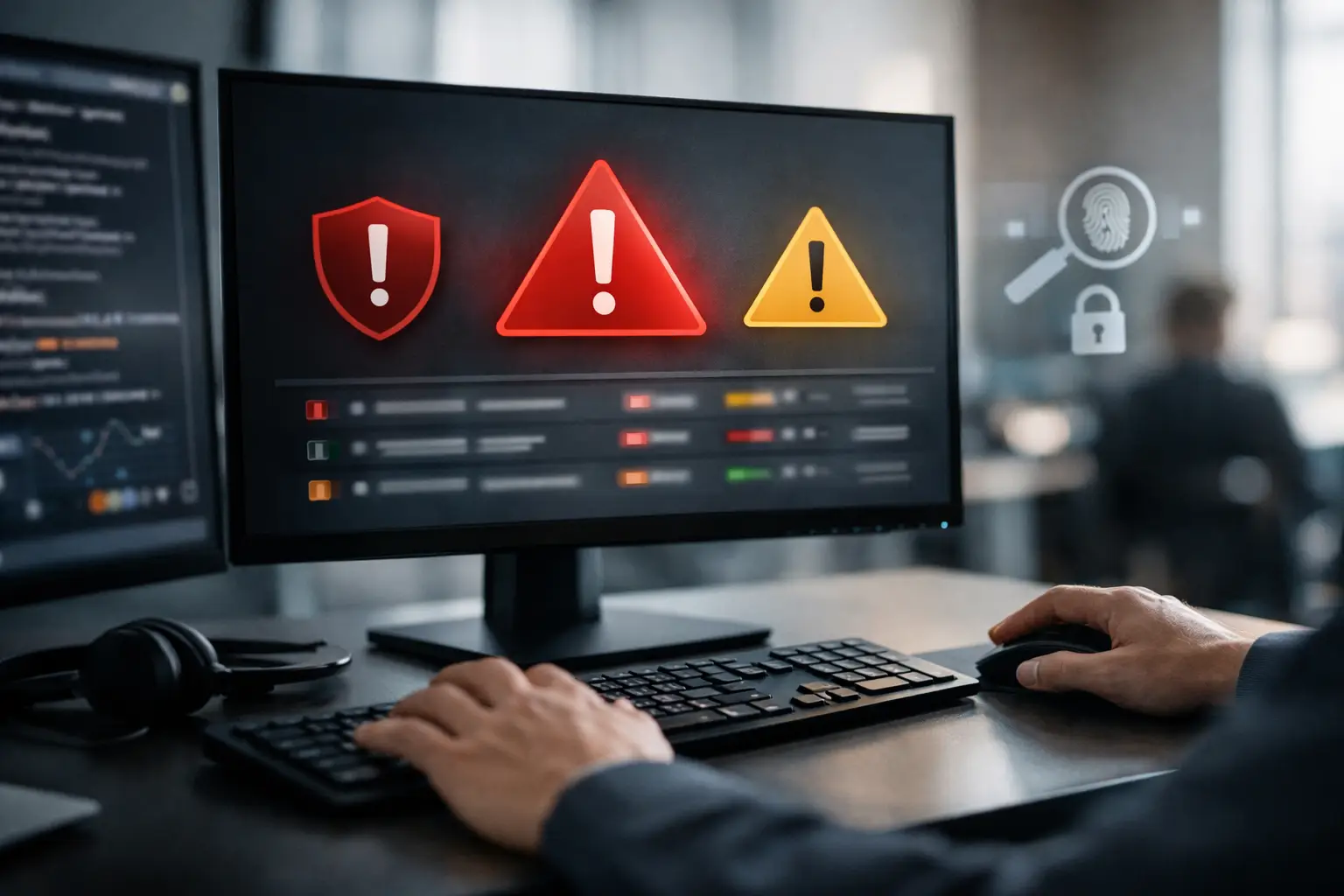
A queue with 2,000 alerts is not a detection problem. It is a decision problem. Knowing how to triage security alerts is what separates a SOC that produces actionable cases from one that burns analyst time on noisy telemetry, duplicate detections, and poorly prioritized escalations.
Alert triage is not the same thing as alert handling. Triage is the fast, disciplined process of deciding what deserves deeper investigation, what can be closed, and what should be suppressed, tuned, or grouped. The goal is not to prove every alert true or false with perfect certainty. The goal is to reduce uncertainty fast enough to protect response capacity.
How to triage security alerts in a real SOC
In practice, triage works best as a repeatable sequence: validate the detection, establish business context, enrich with supporting telemetry, score likely impact, then decide whether to escalate, contain, monitor, or close. The order matters because analysts often waste time enriching alerts that should have been discarded in the first minute.
Track Threat Intelligence like this every Monday.
Every Monday, the 5 threats SOC teams can't afford to miss — with analyst commentary.
Start with the detection itself. Ask whether the alert is structurally sound before asking whether the activity is malicious. Was the rule triggered by complete data or partial telemetry? Did field mappings change after an ingest update? Is the timestamp coherent across source systems? A malformed alert can look urgent while being analytically useless.
Next, identify the object under alert. That means the actual host, account, container, mailbox, workload, or application instance involved - not just the entity label in the SIEM. The question is simple: what is this thing, who owns it, and how exposed is it? An impossible travel alert on a disabled service account has very different implications than the same alert on a privileged cloud administrator with recent MFA changes.
Then check whether the signal is unique or part of a cluster. Duplicate alerts from EDR, identity provider, firewall, and email telemetry can create a false sense of scale. If multiple tools are describing the same event chain, group them into one analytical unit. If they are independent detections on the same asset, that raises confidence and may justify immediate escalation.
Build the first-minute decision
The first minute of triage should answer four questions. Is the alert technically valid? Is the affected asset or identity sensitive? Is there corroborating telemetry? Is the observed behavior consistent with known benign activity? If you cannot answer at least two of those quickly, the issue may be telemetry design rather than analyst performance.
This first-minute decision is where mature teams outperform busy teams. They do not read every log line up front. They check the minimum evidence needed to place the alert into one of a few operational states: likely benign, needs enrichment, high-confidence suspicious, or immediately actionable.
A useful mental model is to separate confidence from severity. Analysts often conflate them. High severity does not mean high confidence. A detection tied to domain controller authentication anomalies may be severe because of the asset class, but confidence might still be low if the rule is known to fire on backup tooling or administrative scripts. Conversely, a medium-severity alert with strong process ancestry and network evidence may deserve faster handling.
Prioritization depends on context, not just rule severity
Most missed escalations happen because prioritization logic is too dependent on vendor-defined severity. That is rarely enough. A practical triage model weighs at least five dimensions: asset criticality, identity privilege, detection fidelity, attack chain position, and blast radius.
Asset criticality is obvious but often stale. CMDB labels are useful only if they are current. A low-profile Linux host may actually be a build server with code signing access. Identity privilege is equally important. Suspicious behavior on a local workstation account is one thing; the same behavior on a break-glass account is another.
Detection fidelity should be measured empirically. If a rule has produced 90 percent false positives over the last 30 days, analysts should treat it differently from a rule with a strong track record. Attack chain position matters because early-stage commodity phishing and late-stage lateral movement should not occupy the same queue logic. Blast radius asks whether the entity can affect one user, one business unit, or the whole enterprise.
This is also where threat intelligence can sharpen triage instead of cluttering it. IOC matches alone rarely justify escalation unless the indicator is high-confidence, current, and relevant to the environment. Threat intelligence is more valuable when it helps interpret behavior: infrastructure overlaps with active intrusion sets, malware family tradecraft, targeting patterns, or post-exploitation techniques seen in recent campaigns. For a platform like Cyber Threat Intelligence, that operational connection between signal and adversary behavior is where content becomes usable in the SOC.
Enrichment should answer specific questions
Analysts lose time when enrichment becomes open-ended hunting. Triage enrichment should be narrow. Every data pull should answer a question that changes the decision.
If the alert involves process execution, enrichment should establish lineage, signer reputation, command-line intent, parent-child relationships, file prevalence, and whether the binary appeared elsewhere in the environment. If the alert involves identity misuse, enrichment should look at authentication source, device posture, MFA events, impossible travel artifacts, session creation, role changes, and token abuse indicators. If the alert involves network behavior, check destination reputation, protocol consistency, JA3 or TLS characteristics if available, beaconing patterns, and whether egress aligns with expected application behavior.
The key is to avoid collecting ten facts when two would settle the case. For example, if an endpoint alert shows powershell.exe spawned from winword.exe with an encoded command, and proxy logs show a follow-on connection to newly registered infrastructure, the triage outcome is already clear enough for escalation. More enrichment may be useful later, but it should not delay containment or case ownership.
False positives still teach you something
A closed alert should not be treated as wasted effort. High-volume false positives usually point to one of three problems: a rule that lacks environmental context, missing suppression logic for known-good behavior, or a data quality issue.
That distinction matters. If a rule correctly identifies suspicious behavior but fires on approved admin tooling, suppression may be the right answer. If the rule is too broad and repeatedly triggers on routine operations, the logic needs tuning. If the problem is parsing drift, hostname normalization failure, broken enrichment, or delayed ingestion, the fix belongs in the pipeline, not in analyst playbooks.
Teams that triage well feed those outcomes back into engineering. Otherwise the queue never improves. Alert triage is partly an analyst skill and partly a detection quality control function.
How to triage security alerts without burning out analysts
Burnout usually follows two conditions: too many low-value alerts and too much ambiguity in decision-making. A triage process should reduce both. Analysts need clear closure criteria, clear escalation thresholds, and a small number of standard evidence checks for each alert family.
This is where detection-specific triage notes are more useful than generic runbooks. A generic playbook saying review logs, check context, and assess risk does not help much. A good triage note says this alert is usually benign when the parent process is the corporate software deployment agent, but escalate immediately if it occurs on a Tier 0 asset or the command line includes credential access artifacts.
Queue design matters too. If the same analyst is expected to triage phishing, cloud IAM anomalies, EDR behavioral detections, and OT network alerts with one uniform SLA, quality will drop. Specialization by alert family or at least by telemetry domain leads to faster pattern recognition and fewer weak escalations.
Automation can help, but only where logic is stable. Auto-closing alerts based on shallow heuristics can hide slow intrusions. Safer automation includes entity enrichment, duplicate grouping, prevalence lookups, known-good suppression, and case templating. Full decision automation should be reserved for narrow alert classes with proven precision.
What mature triage looks like
Mature triage is measurable. Teams should know mean time to first decision, escalation rate by detection, closure reason distribution, duplicate rate, and false-positive rate by rule and by log source. Without that, triage quality is mostly anecdotal.
It is also adaptive. During active campaigns, the same baseline process may need temporary biasing. If there is ongoing exploitation of edge devices, suspicious authentication or outbound activity tied to those assets may warrant a lower threshold for escalation. If a ransomware affiliate is actively using valid accounts in your sector, identity anomalies should move up the queue even when initial evidence is thin.
The practical standard is not perfection. It is consistency under load. The teams that get triage right are not the ones reading the most alerts. They are the ones making the best first decisions with the least wasted motion.
If your alert queue keeps growing, do not ask analysts to work faster first. Ask whether your triage process is forcing them to answer questions the detection stack should have answered already.
Source: https://cyberthreatintelligence.net/how-to-triage-security-alerts-effectively