


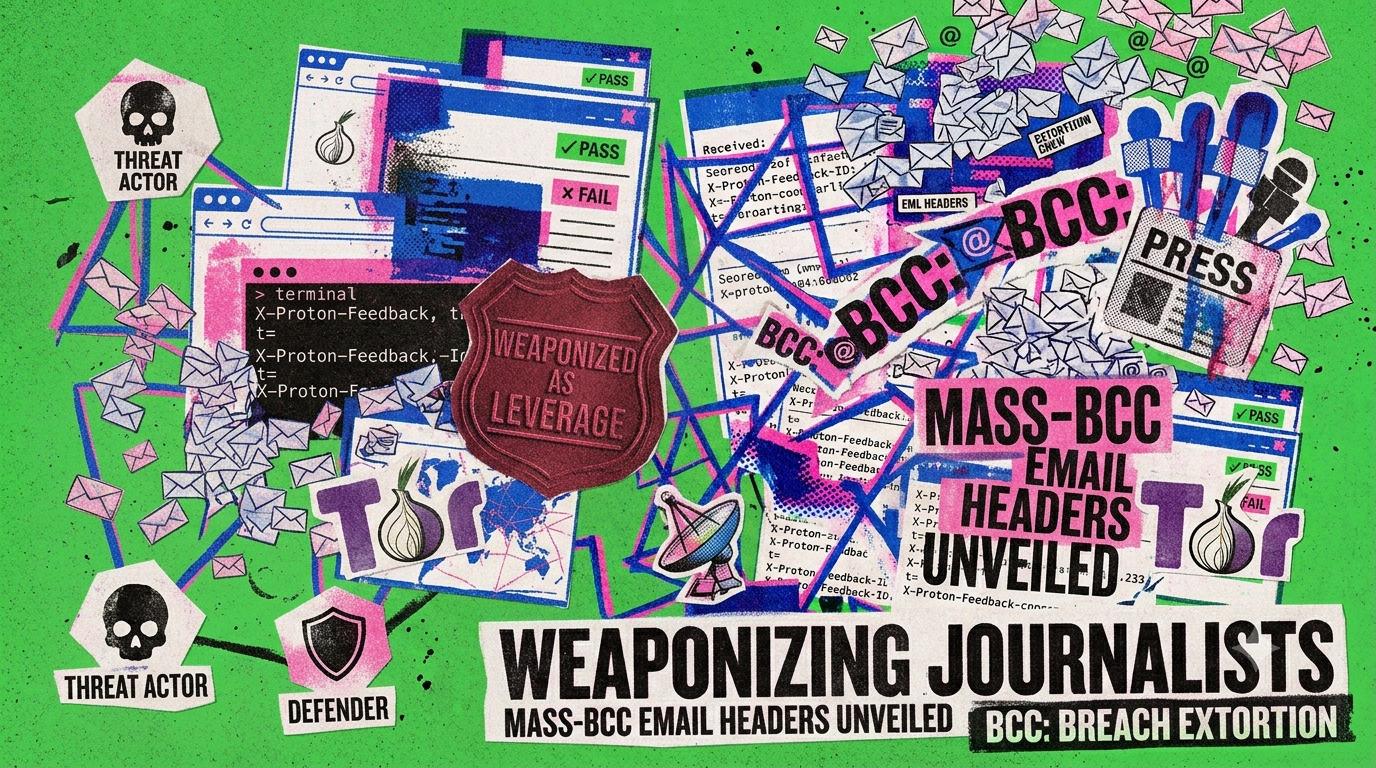
A "Breach Notification" Lands in Your Inbox, and You Are the Leverage
The email arrives unsolicited, addressed to no one in particular, with a line near the top telling you that you have been BCC'd alongside other journalists. The sender claims to hold several million records exfiltrated from a mid-sized company, describes the data in enough detail to sound credible, and blames the victim's leadership for the compromise. Then comes the actual request. Before any proof changes hands, the sender wants assurance that a story will be published and that someone will call the company for comment. No comment is even necessary, the email helpfully notes. They just want to make sure the target is aware.

Read that structure again, because the sequence is the whole game. Publication is requested before evidence is offered. The call to the victim is the point, not a journalistic courtesy. What looks like a tip is a request to operate a pressure lever, and the person holding the lever is the recipient. This is mass-BCC extortion, and it has become a routine third-party pressure tactic in the data-extortion ecosystem. The actor doesn't need the journalist to believe them. They need the journalist to act, because the victim receiving a "we're getting media calls about your breach" moment is worth more to the negotiation than any leak site post.
Track Threat Intelligence like this every Monday.
Every Monday, the 5 threats SOC teams can't afford to miss — with analyst commentary.
The tactic works on a specific weakness: the reflex to treat inbound breach claims as newsworthy tips rather than as moves in an extortion operation. Analysts and reporters who cover this space are a targeted distribution channel now, and the emails are written to exploit exactly that. Understanding the mechanics is what lets you avoid becoming an unpaid participant.
Why the Email Is Structured the Way It Is
Extortion communications have a grammar, and once you've seen a few, the mass-BCC breach email reads like a form letter with the serial numbers filed off. Each element is doing a job in a negotiation you can't see.
The mass-BCC framing itself is the first tell. Telling recipients they've been BCC'd alongside "other journalists" manufactures a sense of a breaking story with competitive urgency, and it obscures who else actually received it. You have no way to know whether the email went to fifty reporters or two, whether the "other journalists" exist, or whether the framing is pure fabrication to make you feel like the story is already moving without you. Legitimate breach disclosure, from a researcher or a whistleblower, almost never opens by telling you that a press pool has been assembled.
The demand structure is inverted from any real tip. A source with a genuine public-interest disclosure leads with evidence and lets the reporter decide whether it's a story. An extortion actor leads with the request for publication and offers evidence only after. The proof is dangled ("I would be happy to provide a sanitized sample set"), conditioned on the outcome the actor wants. That inversion, publish first and verify later, is a red flag that the primary goal is pressure rather than disclosure.
The victim-blaming narrative is not incidental either. These emails frequently editorialize about the target's leadership, claiming the breach resulted from executive greed, negligence, or refusal to fund security. The purpose is to pre-load the story's framing and to add a shame dimension to the extortion, giving the victim a reputational reason to pay beyond the raw data exposure. When an unsolicited breach claim comes packaged with a ready-made villain narrative about the company's executives, that's marketing copy for the extortion, not a finding.
The self-deprecating technical description ("it was not a sophisticated breach, just a simple misconfiguration") serves the same shaming function. It's engineered to make the victim look incompetent and the exposure look inexcusable, which raises the psychological cost of not paying.
Even the choice of infrastructure carries information. These messages routinely originate from privacy-focused webmail like Proton, and the sender name and the address often gesture at the victim while claiming to withhold it ("the company name is in our email address, take a hint"). The theatrical partial reveal is designed to feel like a controlled leak, reinforcing that the actor is calibrating what becomes public and can turn the dial further.
The Consulting Fee Euphemism and the Non-Sophisticated Breach
Two phrases in these emails deserve specific attention because they recur across campaigns and both are deliberate.
"Consulting fee" is extortion laundered into business language. Actors in this space have largely abandoned the word ransom in their outreach to third parties, favoring framings like consulting fee, bug bounty, or a security service the victim declined to purchase. The euphemism does two things. It gives the actor a veneer of legitimacy when the message reaches outside parties, and it reframes the victim's refusal to pay as an unreasonable business decision rather than a refusal to fund crime. When you see "they were unresponsive to our demands for a consulting fee," translate it back: the victim declined to pay an extortion demand, which is the normal and often legally advised response.
The insistence that the breach was trivial ("a very simple misconfiguration") is worth flagging as an analytical matter, not just a rhetorical one. It's usually unverifiable from the outside, it's self-serving because it maximizes the victim's embarrassment, and it may be entirely false. An actor claiming a misconfiguration might have used stolen credentials, a purchased access broker foothold, or a vulnerability they'd rather not disclose. The stated cause of a breach, delivered by the party extorting the victim, is one of the least reliable pieces of information in the entire message. Treat root-cause claims in these emails as narrative, not intelligence.
What the Email Headers Do and Don't Tell You
Before you assess the claim, assess the message. The raw headers of one of these emails are worth reading in full, because they establish what's actually verifiable and, more usefully, expose the gap between message authenticity and content truth. Pull them with "Show original" in Gmail, "View source" in most webmail panels, or by opening the raw .eml. A few fields carry most of the signal.
Authentication results are the first thing people misread. These emails frequently pass DKIM cleanly, and that's expected, not reassuring. If the actor is using a real mailbox on a privacy-focused provider like Proton, the provider signs the message with its own valid DKIM key, so dkim=pass header.d=proton.me is a true statement that the message came unmodified from that provider's infrastructure. It says nothing about the truth of the breach claim. This is the same category error as trusting a package because it has valid provenance: a cryptographic pass verifies origin, not honesty. SPF is often softer. You'll commonly see an SPF softfail rather than a hard pass, because the provider's outbound relay doesn't strictly match the domain's authorized senders under the domain's ~all policy. A softfail here is a normal artifact of how these providers relay mail, not evidence of spoofing, and DMARC still passes on the strength of the DKIM signature.
The Received chain is where people expect to find the sender and where, with these providers, they won't. The earliest Received hop shows the provider's own outbound server, not the actor's client IP. Proton and similar services deliberately strip the originating client address, so the chain gives you the provider's egress node and nothing about the human behind it. That's a property of the provider's privacy model, not a sign of unusual operational security by the actor, and it means geolocation from headers is a dead end for this class of sender. Treat the absence of a client IP as expected, not suspicious.
Two fields do carry useful residue. Timestamp comparison across the Date header, the DKIM t= value, and the receiving Received lines can reveal the sender's configured timezone. A client set to UTC while the rest of the world's mail from that region carries a local offset is a small behavioral tell, consistent with either deliberate timezone obfuscation or automated sending, though never conclusive on its own. And provider-specific abuse identifiers, like Proton's Feedback-ID, tie the message to a specific account on the provider's side. You can't resolve that to an identity, but the provider can, which makes it the single most actionable field in the whole header block for an abuse report. Extortion violates every mainstream provider's terms of service, and that identifier is what lets them action it.
The body encoding is worth a glance too. These messages often carry both plaintext and HTML parts, base64-encoded, and the HTML frequently retains editor metadata (rich-text styling attributes, list-formatting markers) that indicates the message was hand-composed in the provider's web composer rather than generated by a bulk-mail engine. That's a small point, but it distinguishes a manually operated extortion attempt from an automated spam run, which matters when you're gauging how targeted the outreach is.
The summary that headers support is narrow and important: they can confirm the message genuinely originated from the claimed provider account, unmodified, at a certain time. They cannot confirm a single word of the breach claim. Authenticity of the envelope and truth of the contents are different questions, and conflating them is exactly the mistake these emails are built to induce.
How to Verify a Breach Claim Before Amplifying It
None of this means every unsolicited breach claim is fake. Some are real, and real breaches are legitimately newsworthy. The discipline is verification before amplification, and specifically verification that doesn't route through the actor's own controlled proof. Here's the sequence that keeps you out of the extortion loop.
Start with the data, on your terms, not theirs. A sanitized sample the actor selects and formats is proof of nothing except that they can produce a plausible-looking spreadsheet. If you're going to assess a claim, you want to independently derive indicators: does any exposed email or credential appear in existing breach-notification datasets, does the record structure match the claimed source's known systems, do timestamps and identifiers internally cohere. The actor's curated ten-record sample is designed to pass a glance and reveal nothing checkable.
Verify the victim through independent channels before contacting them, and be deliberate about what that contact does. This is the pivotal decision. The email is engineering you into calling the company, because that call is the pressure the actor is buying. There's a real distinction between responsible disclosure and extortion facilitation, and the line is whether your contact serves the public or serves the actor's timeline. If a claim warrants verification with the victim, that outreach should happen on a security-reporting or press channel, framed as a verification request, and it should never relay the actor's demands or deadlines. You are not a courier. The moment your message to the victim carries the actor's terms, you've been recruited.
Corroborate against the wider ecosystem. Real extortion operations usually leave more than one trace. Check whether the actor name appears on known data-leak sites, in prior reporting, or in threat-intel tracking. A crew running mass-BCC campaigns often has a Tor leak site, a track record, and a pattern. A brand-new name with no footprint and a single dramatic email is a different confidence tier than an established operation with a verifiable history, and both differ from a claim you can independently substantiate through the exposed data itself.
Assume the sender is reading your coverage as a negotiation signal. If you do publish, understand that the actor will screenshot it and send it to the victim as evidence that the pressure campaign is working. Reporting on the tactic is defensible. Naming an unverified victim on the strength of an extortionist's word is not, and it exposes you to defamation risk if the claim is wrong or inflated, which it frequently is. The safest and most useful coverage focuses on the method and withholds the victim's identity until it's independently confirmed and the confirmation comes from somewhere other than the person doing the extorting.
What This Looks Like From the Victim's Side
If you're on a security team and your organization is the one being named in these emails, the dynamics invert and a few things are worth knowing.
You will often learn about the mass-BCC campaign from a journalist's verification request rather than from the actor directly, or you'll learn about it in parallel. That inbound press contact is frequently the first external signal that the actor has escalated to third-party pressure, which means your comms and security teams need a pre-agreed protocol for handling breach-related media inquiries during an active extortion situation. An improvised response under deadline pressure is exactly what the actor is counting on.
The presence of a media-pressure component is itself intelligence about where the negotiation stands. Actors typically escalate to journalists when direct extortion has stalled, which the emails sometimes admit outright by complaining that the victim has been unresponsive. That unresponsiveness, from the defender's side, may well be the correct posture, and the escalation to media is a sign the actor is running low on direct leverage rather than a sign the situation is deteriorating. Read the escalation as a status indicator, not a reason to change course, and make that call with legal and IR counsel rather than in reaction to a reporter's deadline.
Preserve everything. The email itself, headers included, is an artifact. The sending infrastructure, the timing relative to your incident timeline, the specific data categories claimed, and the language used all feed both the IR investigation and any law-enforcement engagement. The claimed scope ("7 to 8 million records spanning from 2013 to present") is a lead to validate against your actual data footprint, not a fact to accept, and the gap between what they claim and what they can prove is often the most useful thing in the whole message.
The Broader Pattern Worth Tracking
Mass-BCC journalist targeting sits inside a larger shift in how extortion crews apply pressure. The move over the past few years has been away from pure encryption toward data theft and multi-point pressure: leak sites, direct emails to customers and partners, regulatory-complaint threats, harassment of executives, and now systematic media seeding. Each channel exists to raise the cost of not paying, and the media channel is attractive precisely because it's free, scalable, and outsources the pressure to people who believe they're doing journalism.
The countermeasure isn't complicated, but it requires treating these emails as what they are. An unsolicited breach claim that requests publication before offering proof, packages a victim-blaming narrative, euphemizes the ransom as a fee, and nudges you toward calling the target is not a tip. It's a request to join an extortion operation as the pressure arm. The reporting that actually serves readers is the reporting on the mechanism, done without becoming a case study in it, and the analysts who get this right are the ones who internalize that the actor's goal was never to inform them. It was to use them. The only real decision the email leaves you is which side of that you want to be on.