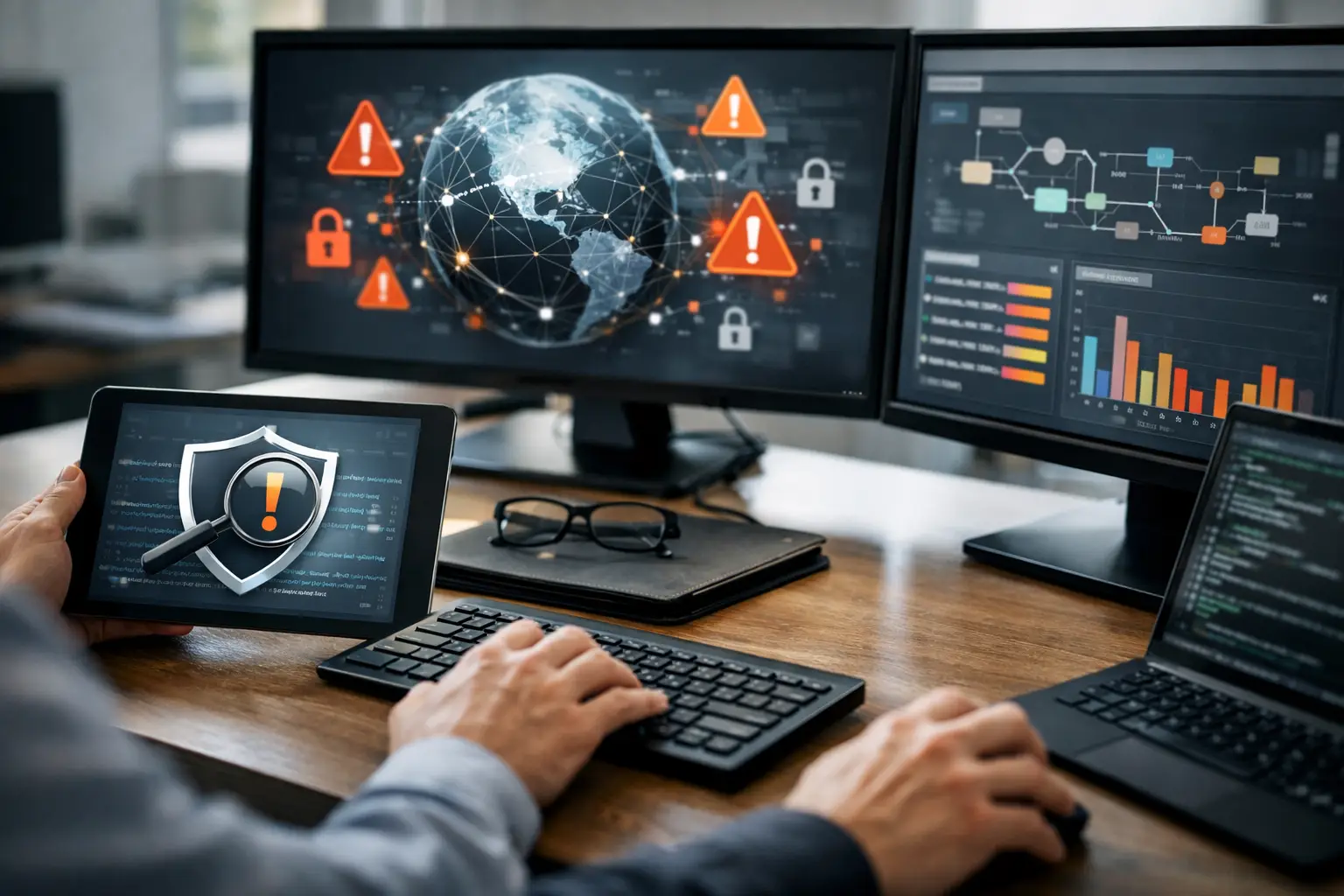



At 2:13 a.m., the SIEM fires a high-severity alert for suspicious PowerShell spawned by a signed Microsoft binary on a finance endpoint. The alert alone does not tell you whether this is admin activity, brittle detection logic, or the opening stage of an intrusion. That gap between signal and decision is exactly where the question what does a SOC analyst do stops being career-page fluff and becomes operational reality.
A SOC analyst is the team member who turns security telemetry into action. In mature environments, that means far more than watching dashboards and escalating obvious malware. The role sits at the intersection of detection engineering, incident triage, log analysis, threat context, and operational communication. The analyst is often the first person to determine whether an event is benign, suspicious, or actively malicious, and that determination shapes containment speed, evidence preservation, and downstream incident scope.
What does a SOC analyst do in practice?
The short answer is that a SOC analyst monitors, validates, investigates, and escalates security events. The more accurate answer depends on the SOC model, tooling maturity, staffing depth, and whether the team is built around true 24x7 detection and response or mostly alert handling.
Track Threat Intelligence like this every Monday.
Every Monday, the 5 threats SOC teams can't afford to miss — with analyst commentary.
In a smaller SOC, one analyst may review email security alerts, EDR detections, cloud anomalies, authentication events, firewall logs, and vulnerability findings in the same shift. In a larger program, those responsibilities split across Tier 1, Tier 2, threat hunting, detection engineering, DFIR, and intelligence functions. Even then, the SOC analyst remains the control point where data is interpreted under time pressure.
The work usually starts with triage. Analysts review alerts from SIEM, EDR, NDR, IAM, cloud-native telemetry, and security gateways, then assess severity, confidence, and business context. A suspicious login from a foreign IP is not automatically malicious. An encoded PowerShell command is not automatically incident-worthy. Analysts validate against asset criticality, user behavior, known admin workflows, recent change windows, and available enrichment such as threat intel, process lineage, and historical baselines.
That triage function sounds basic until volume and ambiguity collide. A SOC analyst is expected to decide quickly without overreacting, while also not normalizing attacker tradecraft simply because it resembles legitimate administration. Good analysts develop pattern recognition, but they also know where intuition fails and evidence has to carry the call.
Core responsibilities inside a modern SOC
Alert handling is only the visible layer. A capable analyst spends a significant portion of time reconstructing activity across multiple data sources. That may involve pivoting from an EDR alert into DNS logs, VPN telemetry, identity provider events, email headers, or cloud audit trails to answer simple but critical questions: What happened first? What changed on the host? Did the account touch other systems? Is there persistence, lateral movement, or data access?
Investigation quality depends heavily on telemetry quality. Analysts work around missing logs, broken parsers, duplicate events, poor asset inventory, and detection rules tuned for compliance optics rather than attacker behavior. In practice, part of the job is compensating for weak visibility while documenting where the environment creates blind spots.
SOC analysts also support incident response. They may not always own full containment or eradication, but they help establish scope, collect indicators, preserve timelines, and hand off validated findings to IR, engineering, or management. In some teams, they isolate hosts, disable accounts, block hashes, or push firewall controls directly. In others, they coordinate through tightly controlled change paths. The exact authority varies, but the investigative burden often lands with the SOC first.
Another core responsibility is detection feedback. If analysts repeatedly close the same noisy alert because a rule is overbroad, that should not remain tribal knowledge in shift notes. Analysts are usually closest to false-positive patterns, logging gaps, and attacker behaviors that existing use cases miss. Mature SOCs treat analyst feedback as input for tuning, correlation improvements, playbook updates, and control validation.
The difference between monitoring and analysis
A weak SOC model reduces the role to queue management. A stronger model treats analysts as decision-makers. Monitoring means watching dashboards for deviations. Analysis means determining whether those deviations map to known-good behavior, expected operational noise, adversary tradecraft, or control failure.
This distinction matters because many security teams still measure SOC performance using metrics that can be gamed easily, such as alert closure volume or mean time to close. High closure rates can coexist with poor detection fidelity, shallow investigations, and missed lateral movement. Analysts who are pushed to clear queues without enough context become operationally efficient and strategically blind.
The best SOC analysts are not just fast. They are careful about evidence, skeptical of incomplete narratives, and aware that a single alert can be the symptom of a broader intrusion chain. They ask whether the telemetry aligns with known TTPs, whether a user action makes sense for that role, and whether adjacent systems show corroborating behavior. They know when to escalate and when to challenge the alert itself.
What tools does a SOC analyst actually use?
The tooling stack usually includes a SIEM, EDR platform, SOAR workflow layer, case management system, threat intelligence platform, packet or network metadata sources, vulnerability context, email analysis tools, and identity telemetry. In cloud-heavy environments, analysts also spend time in AWS CloudTrail, Azure activity logs, Entra ID sign-in data, GCP audit logs, CSPM outputs, and SaaS security events.
But tool access does not equal analytical depth. Plenty of SOCs own expensive platforms while analysts still lack normalized data, meaningful enrichment, or permissions to pivot effectively. A strong analyst learns the environment’s telemetry strengths and weaknesses, including where timestamps drift, where process lineage breaks, and which detections have unreliable confidence.
That practical knowledge is often more valuable than vendor certification. Analysts do not need perfect visibility to be effective, but they do need to understand what their tools can prove versus what they merely suggest.
Tiering, specialization, and where the role changes
The answer to what does a SOC analyst do also changes by seniority. Entry-level or Tier 1 analysts usually focus on triage, basic enrichment, case documentation, and straightforward escalation. Tier 2 analysts typically handle deeper investigation, hypothesis testing, malware or script review, scoping, and incident coordination. Senior analysts may overlap with threat hunting, content tuning, purple team exercises, and mentoring.
That said, rigid tier models are not always a sign of maturity. Some organizations use tiering to protect specialists from alert fatigue. Others use it to create escalation bottlenecks where junior analysts never develop investigative depth. In lean teams, the same analyst may perform all tiers during one shift. In MSSP environments, analysts may be technically capable but constrained by client visibility, contractual boundaries, and uneven telemetry coverage.
The role also changes depending on whether the SOC emphasizes enterprise operations, MDR, or cloud-native detection and response. A traditional enterprise SOC may spend more time on Windows endpoints, AD, VPN abuse, and email-borne threats. A cloud-focused SOC may spend more time on identity misuse, OAuth abuse, API activity, privilege drift, storage exposure, and workload anomalies. The analytical method is similar, but the telemetry and attack surface are different.
The skills that matter most
Log analysis remains foundational. Analysts need to read events critically, understand normal versus suspicious authentication flows, recognize command-line abuse, and correlate process, network, and identity evidence without forcing a conclusion too early. Familiarity with attacker tradecraft matters, especially mapped to frameworks like MITRE ATT&CK, but framework fluency is only useful if it improves detection and investigation quality.
Writing matters more than many teams admit. SOC analysts constantly translate technical findings into case notes, escalations, and status updates that others rely on for response decisions. Poor documentation creates duplicated work, weak handoffs, and bad assumptions during live incidents.
Context is the multiplier. Analysts who understand the business environment make better calls than those who treat every anomaly as equal. A suspicious process on a kiosk device, a domain controller, and a build server should not be interpreted the same way. The same applies to user behavior, maintenance windows, and approved admin tooling.
Why the role is harder than it looks
The pressure point in SOC work is not only technical complexity. It is making defensible decisions with incomplete data while balancing speed, accuracy, and fatigue. Analysts deal with noisy detections, recurring benign anomalies, after-hours escalation, adversary behavior that blends into administration, and organizational pressure to avoid disruption. They are asked to find meaningful threats in environments where logging is often fragmented and ownership is distributed.
This is why mature SOC operations invest not just in tools, but in tuning discipline, content engineering, asset context, playbook quality, and feedback loops between SOC, IR, engineering, and threat intelligence. A SOC analyst is most effective when the organization treats analysis as a core security function rather than a human buffer in front of a ticket queue.
For teams that follow Cyber Threat Intelligence and adjacent operational research, that distinction is familiar: raw indicators and alerts are rarely enough on their own. The work that matters happens in correlation, validation, and decision-making.
If you want the most accurate one-line answer, it is this: a SOC analyst reduces uncertainty during security events. Sometimes that means closing a false positive with confidence. Sometimes it means identifying the first reliable sign that a real intrusion is underway. The value is not in staring at alerts. It is in knowing what they mean, what they do not mean, and what needs to happen next.
Source: https://cyberthreatintelligence.net/what-does-a-soc-analyst-do